




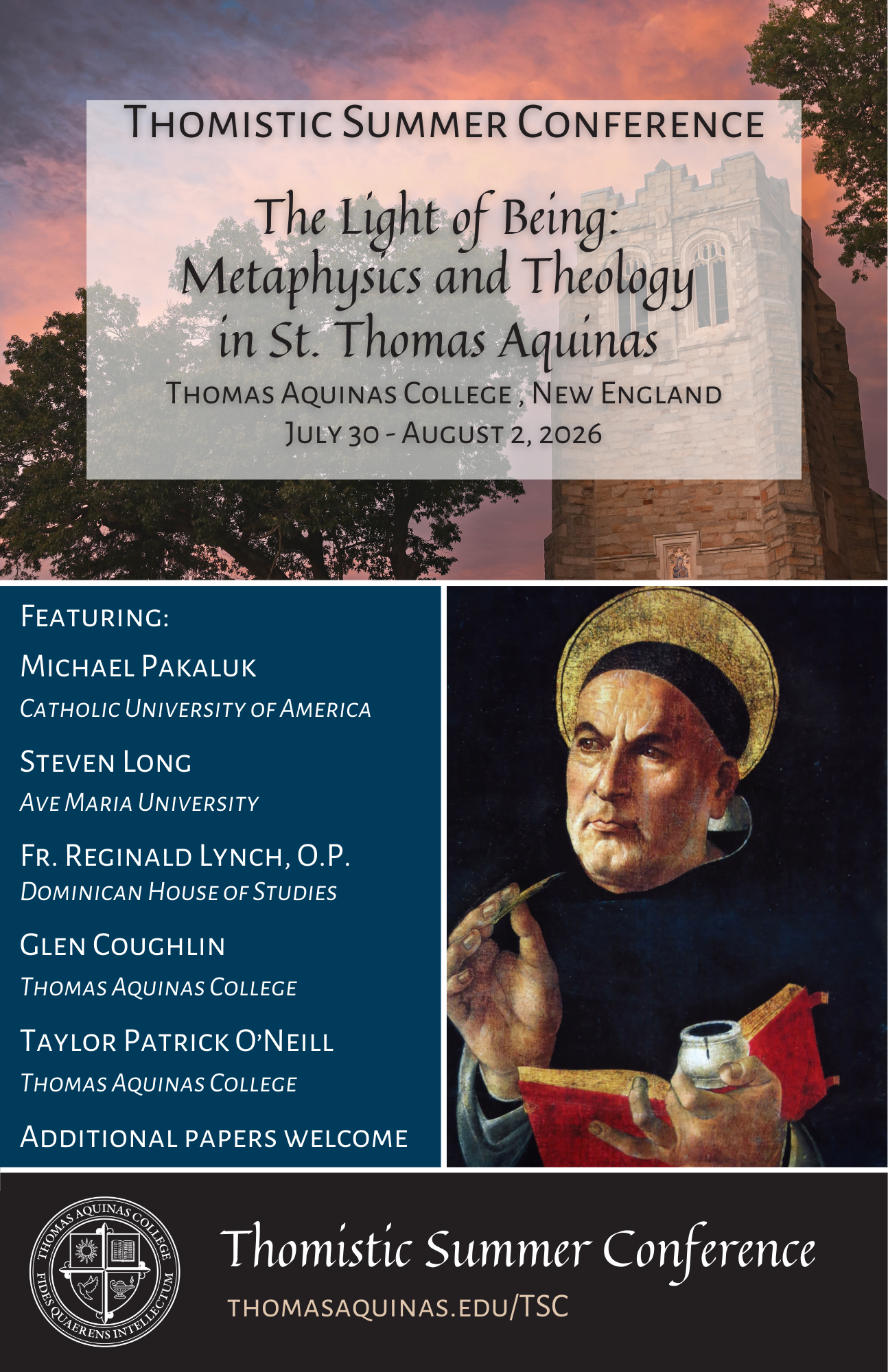
Pope St. John Paul II taught that “a philosophy which shuns metaphysics would be radically unsuited to the task of mediation in the understanding of Revelation… Metaphysics thus plays an essential role of mediation in theological research” (Fides et Ratio, 83). As the Church has affirmed for centuries, this principle is nowhere more profoundly embodied than in the theology of St. Thomas Aquinas.
This conference invites theologians and philosophers to explore metaphysics itself and the ways it continues to shape and support theological inquiry. Possible areas of exploration include (but are not limited to) the metaphysical foundations of doctrine, analogy and theological language, creation and participation, divine simplicity and causality, grace and nature, Christology and sacramental theology, and the order of the sciences. Contributions that directly unfold St. Thomas’s understanding of the order of learning and the role of metaphysics in theology are especially welcome.
Thomas Aquinas College’s Fifth Annual Thomistic Summer Conference invites those who seek the truth in the footsteps of the Angelic Doctor to join fellow scholars for three days of engaging lectures and lively conversation on the relationship between metaphysics and theology. This gathering will mark the inaugural Thomistic Summer Conference held in New England.
Featured Speakers
 Michael Pakaluk is Ordinary Professor of Political Economy in the Busch School of Business in The Catholic University of America and Ordinarius of the Pontifical Academy of St. Thomas Aquinas. A noted scholar of Aristotelian and Thomistic ethics and natural law, his most recent books are The Shock of Holiness (Ignatius), The Company We Keep (Scepter), and Be Good Bankers: The Economic Interpretation of Matthew’s Gospel (Regnery). His collected papers on natural law and civic friendship are forthcoming from The Catholic University of America Press.
 Steven A. Long is Professor of Theology at Ave Maria University. He holds a Ph.D. in philosophy from the Catholic University of America. He has previously taught at the University of St. Thomas (MN), at St. Joseph’s College, Christendom College, and The Catholic University of America. He is the author of The Teleological Grammar of the Moral Act, (Sapientia Press, 2007), Natura Pura: On the Recovery of Nature in the Doctrine of Grace (Fordham University Press, 2010), and Analogia Entis: On the Analogy of Being, Metaphysics, and the Act of Faith (University of Notre Dame Press, 2011). He is a permanent member of the Pontifical Academy of St. Thomas Aquinas (PASTA).
 Fr. Reginald Lynch, O.P. is a Dominican priest of the Province of St. Joseph, and an Associate Professor at the Dominican House of Studies in Washington DC. Fr. Reginald received his PhD from the University of Notre Dame, in 2020 with a concentrations in Medieval and Patristic Theology; His research focuses on a range of issues in the History of Christianity area, especially medieval and early modern theology. He has written two books, The Cleansing of the Heart: The Sacraments as Instrumental Causes in the Thomistic Tradition (CUA, 2017) and Aquinas’s Summa Theologiae and Eucharistic Sacrifice in the Early Modern Period (Oxford, 2024)
 R. Glen Coughlin has taught for nearly forty years at the California campus of Thomas Aquinas College, where he previously served as Dean. Over the course of his career, he has taught the entire curriculum of the College. His translations, with commentary, of Aristotle’s Physics and De Anima are published by St. Augustine’s Press. His scholarly work, focusing primarily on Aristotelian and Thomistic natural philosophy and metaphysics, has appeared in The Thomist, Philosophia Perennis, and The Aquinas Review.
 Taylor Patrick O'Neill teaches at Thomas Aquinas College. His book Grace, Predestination, and the Permission of Sin: A Thomistic Analysis was published by CUA Press in 2019. He has also been published by Nova et Vetera, T & T Clark, Emmaus Academic, Sapientia Press, Ignatius Press, First Things, and others. He is the editor of Lux Veritatis: A Journal of Speculative Theology and the President of The Sacra Doctrina Project.
Registration / Accommodations Info
- Early Bird Fee: $95, available until May 15.
- Registration Fee: $120 (covers all meals, including Saturday evening’s banquet dinner). Registration fees will be waived for those whose paper proposals are accepted.
- Registation Deadline: June 15
- On-Campus Lodging: $200 single occupancy for up to four nights (Wednesday, Thursday, Friday, Saturday; private room with a shared/common bathroom in a single-sex dormitory; linens provided)
- Off-campus lodging can be found at various nearby accommodations
- To register and reserve accommodations, please visit our online form
- Check-in: Wednesday, 2:00–5:00 p.m., or Thursday, 8:30–10:00 a.m.
- Deadline to Request Rides from Hartford Airport, Boston Airport or the Greenfield Amtrak Station: June 30
Registereee
Thomas Aquinas College believes that to learn is to discover and grow in the truth about reality. It is the truth, and nothing less, that sets men free. And because truth is both natural and supernatural, our academic program aims at both natural and divine wisdom. In particular, we look to St. Thomas Aquinas, the Common Doctor of the Church, whose extensive writings testify to the natural harmony between faith and reason.
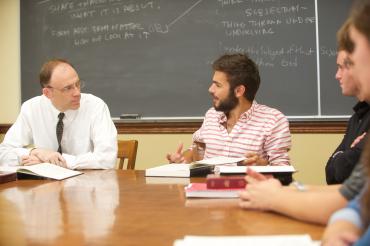
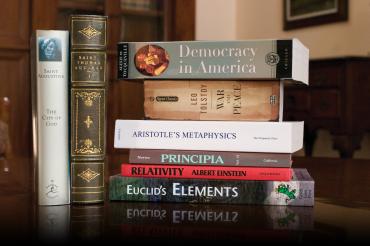
Thomas Aquinas College is truly unique among American colleges and universities. In place of textbooks, students here study the Great Books of Western civilization — the works that have shaped the course of history and guided the development of the major disciplines (mathematics and science, language and literature, philosophy and theology). With truth as their aim, our students engage in this four-year pursuit, attempting to answer the enduring questions raised by the authors of these great works, not in vast lecture halls, but in vigorous classroom discussions of 15-18 students.
This curriculum presents the arts and sciences of liberal education as a comprehensive whole. There are no majors, no minors, no electives, and no specializations. The works studied are arranged so as to build upon one another, and together they form a comprehensive and integrated whole. After four years of study, graduates are awarded a Bachelor of Arts degree, having completed 146 semester hours.